
.png)
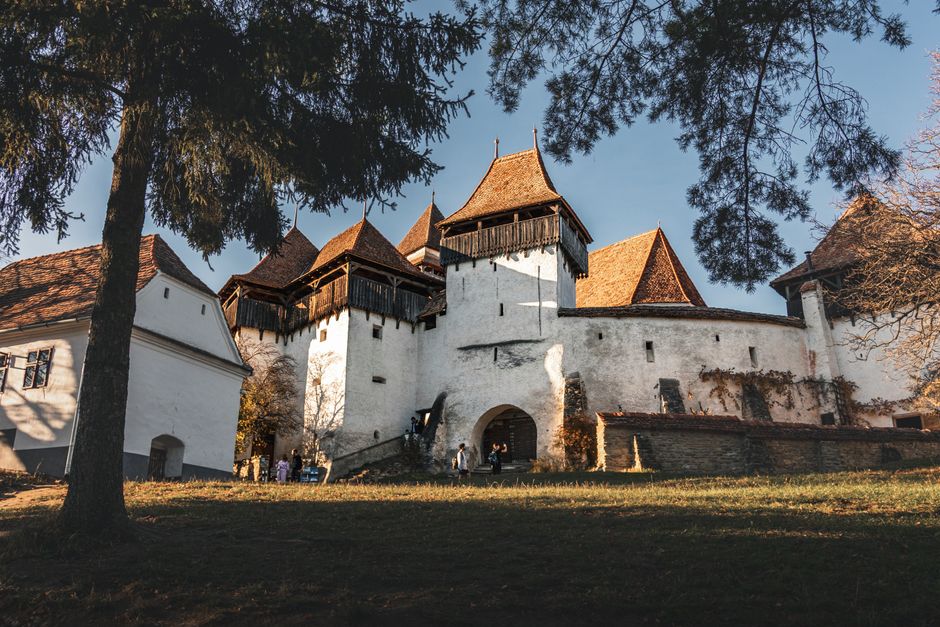
Photo by Filip Marcus Adam on Pexels
Biertan's fortified church locked unhappy couples in a single room for up to six weeks — one bed, one set of cutlery, one cup — until they either reconciled or proved they truly meant it.
That detail stopped me cold when a local guide mentioned it almost as an aside, like it was obvious. It's not obvious. It's one of the strangest, most human things I've encountered in years of traveling through Romania, and it's the reason Biertan deserves its own conversation, separate from the usual Transylvania circuit of Bran Castle and Sighișoara's painted houses.
The village sits about 25 kilometers from Mediaș, in Sibiu County, and it takes some commitment to get there without a car — a bus to Mediaș, then a local connection that runs on its own schedule and nobody seems entirely sure of. Worth it anyway. When you arrive, the church rises above the Saxon houses like it was built to remind everyone who was in charge, which it was. Three rings of defensive walls, towers at the corners, and a lock mechanism on the sacristy door so complex it won a prize at the 1900 Paris World Exhibition. The Saxons who settled here in the 12th century were not casual about anything.
What You're Actually Looking At
UNESCO listed Biertan as a World Heritage Site in 1993, grouped with six other fortified Saxon churches in Transylvania. But unlike some heritage sites that feel curated into stillness, Biertan still has people living around it. Old women sell homemade palincă and jars of pickled vegetables on a folding table near the entrance path. A cat sleeps on one of the wall ramparts with complete indifference to the history beneath it.
Inside the church, the triptych altarpiece from 1483 is the thing to slow down for. It has 28 painted panels that unfold like a story being told to people who couldn't read, which was exactly the point. The colors have faded just enough to feel genuinely old rather than restored into something too clean.
The Divorce Room
Back to that room. It's called the Kemenate in German sources, sometimes referred to locally as the reconciliation chamber. Between 1500 and 1800, only one divorce was recorded in the entire parish. One. The room presumably did its job, though you can debate whether that's a success story or not. Standing in the small stone space, which smells of cold and old wood, it's hard not to think about the conversations that must have happened in there — some resigned, some furious, some probably just exhausted.
Practical Notes
- The church is open daily in summer, roughly 9am to 6pm, with reduced hours in winter — confirm locally because posted schedules are optimistic.
- Admission is a few lei, essentially nothing, and goes toward preservation.
- The village has one guesthouse worth knowing about: Gasthaus Biertan, run by a German-Romanian family who cook dinner if you ask ahead. Breakfast includes proper homemade bread and sheep's cheese that tastes like it was made that morning because it was.
- Combine with a stop in Mediaș or the slightly larger fortified church at Viscri, about 40 kilometers east, for a full day in Saxon country.
Biertan won't overwhelm you with things to do. That's the point. You walk up the cobbled path, you go slowly through the church, you sit outside on the wall with a view of red rooftops and hills that look the same as they did three hundred years ago, and you think about what it means to build something meant to last. Then maybe you buy a jar of pickles from the woman with the folding table. She will seem pleased that you did.
.png)
Please Don't Spam Here. All the Comments are Reviewed by Admin